
Beyond Monoliths and Micro-Frontends: Exploring Route-Based Composition
Most websites start with an empty app and grow inward.
You create a Next.js project. Vite. Vue. Craco. Astro. All of them follow the same
principle: you add pages, a content/ directory, Vitest, a deploy workflow, and
voilà: a website. The source code, content and thing that eventually reaches
production all live in the same place.
The app is the website.
That model works extremely well. Rxova’s website had a different problem: present several independently built applications under one domain without forcing them into one build graph or browser runtime. The composition unit was the route.
First, what is a frontend monolith?
“Monolith” has become one of those words people say as though the architecture has already lost an argument. It has not.
A frontend monolith is one deployable frontend unit. One application owns the route map, page composition, content integration and production artifact. Its code can be modular and split into packages; the boundary that matters is the build. Everything enters one graph and leaves as one release.
Next.js, Vite and Astro are not monolithic architectures by themselves. They are tools. They produce a frontend monolith when one project built with them owns the whole website. They can also participate in other architectures.
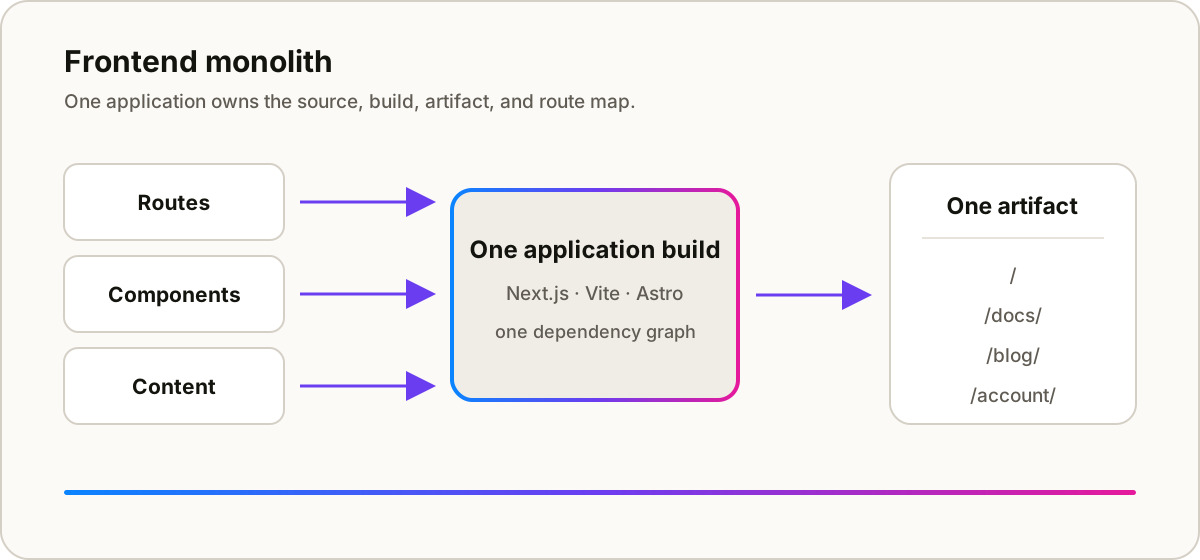
In the usual model, one build owns both the source and the final route map.
Then, what is a micro-frontend?
A micro-frontend moves decomposition beyond internal modules. A vertical slice of the user experience has its own codebase, delivery pipeline and owner. The goal is not merely smaller bundles. It is autonomy: one team should be able to change and release its part of the product without synchronising the whole frontend.
Runtime composition—Module Federation, single-spa, web components—is the familiar
shape, but a micro-frontend can own an entire page. What matters is a meaningful
product boundary that can travel independently to production.
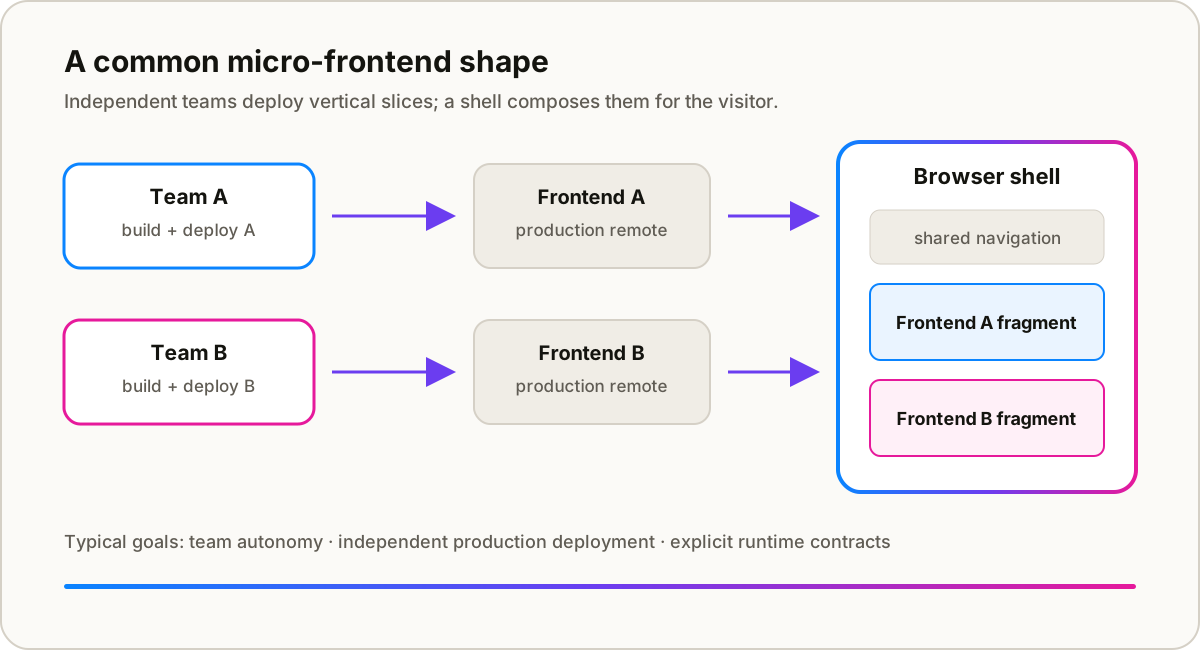
One common form, not the only one: independently deployed slices composed by a browser shell.
The influential micro-frontends description centres autonomous teams, vertical ownership and independent production deployment. Those are organisational properties expressed through technology, not a synonym for “more than one frontend repository.”
Why Rxova’s Website Is Neither a Monolith nor a Micro-Frontend Architecture
Rxova’s website is made from several complete static applications. The landing owns
/. Journey owns /packages/journey/. The blog owns /blog/. Updates owns
/updates/.
Each route owner has its own source, dependencies and build. Documentation lives beside the code it explains, and no application can see every page at build time. Each produces a finished static tree for its path.
Those outputs become one production tree, but no single frontend build produces it. That rules out a frontend monolith.
Micro-frontends is closer: the codebases are independent, can use different frameworks, share no build, and still form one user-facing product. But the label imports expectations that make the actual design harder to see.
Every document belongs to exactly one route owner, so no runtime shell loads one application’s component beside another. Crossing a boundary unloads one document and loads the next. There is no shared React instance, remote module, cross-application state or in-page integration contract.
Most importantly, route owners build independently but do not deploy independently to production. Rxova’s website validates their artifacts, assembles the enabled set and publishes one combined tree.
Micro-frontends is useful ancestry. It is not the most useful name.
The longer implementation story—flags, failed central builds, artifact persistence and the eventual pipeline—lives in How Rxova’s Website Architecture Evolved.
What About the Other Alternatives?
Next.js Multi-Zones is the closest established term. Different applications own different paths on one domain, and crossing a zone causes a hard navigation. But zones remain independently deployed; a proxy or rewrite sends each request to the correct origin. Rxova’s website copies persisted static outputs into one deployment instead.
“Docs portal” describes the product, not the general architecture. “Composed static site” is accurate but does not identify where composition happens.
For this shape, route-based composition is the precise name: one application owns each route subtree, and composition happens at that boundary.
How Route-Based Composition Works
Each route owner builds for its final public base and publishes an artifact. A receiver validates and persists the last accepted version, then assembles the enabled trees or feeds their locations into an origin router.
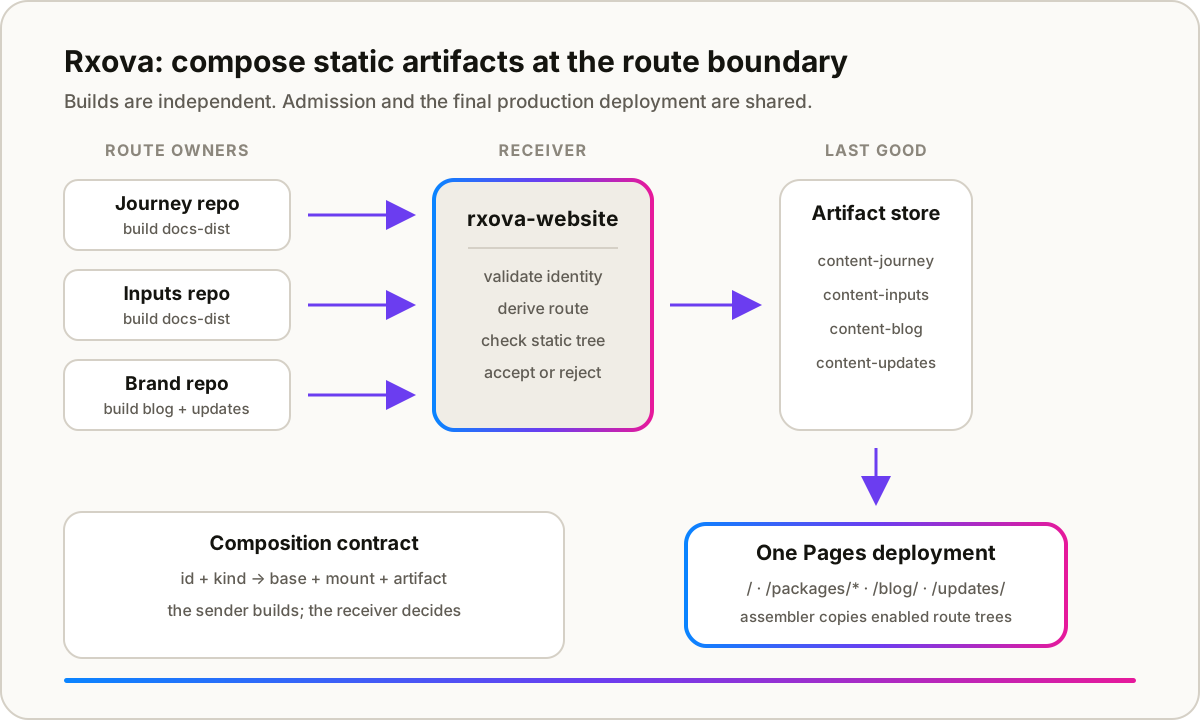
Rxova’s implementation assembles static files. The same route contract could drive a proxy instead.
The path is part of the application contract. A static tree built for / and moved
under /packages/journey/ can return a healthy index.html while every stylesheet
and script returns 404. The public base, mount and artifact identity therefore need
to come from one source of truth.
The receiver is authoritative: a route owner may offer an artifact but cannot mount itself. Bad input leaves production untouched; a missing enabled route stops the deployment rather than publishing a hole.
Shared design is a separate contract. Route owners consume @rxova/brand, a
versioned package of tokens and shared chrome. That introduces a genuine
micro-frontend problem—version skew—because a canonical package cannot force
consumers to upgrade.
When This Boundary Works
Route-based composition fits separately owned or versioned products with different frameworks and cadences, route-level isolation, and no shared runtime state.
It is a poor fit for a flow that constantly crosses boundaries, shares client state or needs several teams to render into one document. It is unnecessary when one application can own everything. A hard navigation should be an acceptable property of the boundary, not an accident users pay for repeatedly.
Rxova’s implementation is cheap because npm and GitHub already provide distribution, dispatch, storage and hosting. It is not vendor-neutral; its underlying contract is more portable:
source identity + route kind
  -> derived public base
  -> independently built artifact
  -> receiver validation
  -> persisted last-good version
  -> route manifest
  -> assembly or origin routing
Conclusion
The frontend world is excellent at both ends of this spectrum.
Frameworks build one application extremely well. Micro-frontend tooling composes independently deployed code in a runtime. Hosting platforms offer proprietary multi-zone routing between applications.
There is less tooling for the middle: independently owned applications composed at route boundaries without requiring one framework, runtime, monorepo or host.
We need portable route manifests, artifact contracts, last-good storage and routing or assembly layers that scale across codebases and teams. The URL is already an open interface; a hard navigation can be a feature when it buys real isolation.
A frontend monolith remains the right choice when the product has one boundary. Runtime micro-frontends remain powerful when several owners must collaborate inside one page. Route-based composition deserves equally good primitives for everything between them.